
Production realities , in a sophisticated machine shop setting. You can’t just re grind an end mill and throw it back in the machine. You have to modify the program, check everything, There are dimensional and surface finish considerations. So. You want to be careful how you go about this. In a perfect world. You would. Unmount the dull tool. Throw it into a small numerical tool grinder. Take a .150 off the end. Put it back in the machine, set your height and go back to work. We’re going to call this GLN (good Like new).
The other classification:Recon
Recon is a reconditioned tool is where original geometry has been altered,there will be known program adjustments, speed and fee varianes, really useful in roughing cycles. (most of the program.
We want the tool room manager to look good. CTM Cutting tool management.
It is part of cost control, part of process control, and part of staying productive when lead times and tool prices move the wrong way. The right machine gives you repeatable edge quality, controlled relief, and enough flexibility to handle the tool mix you actually run. without becoming a management problem
What an end mill sharpening machine needs to do
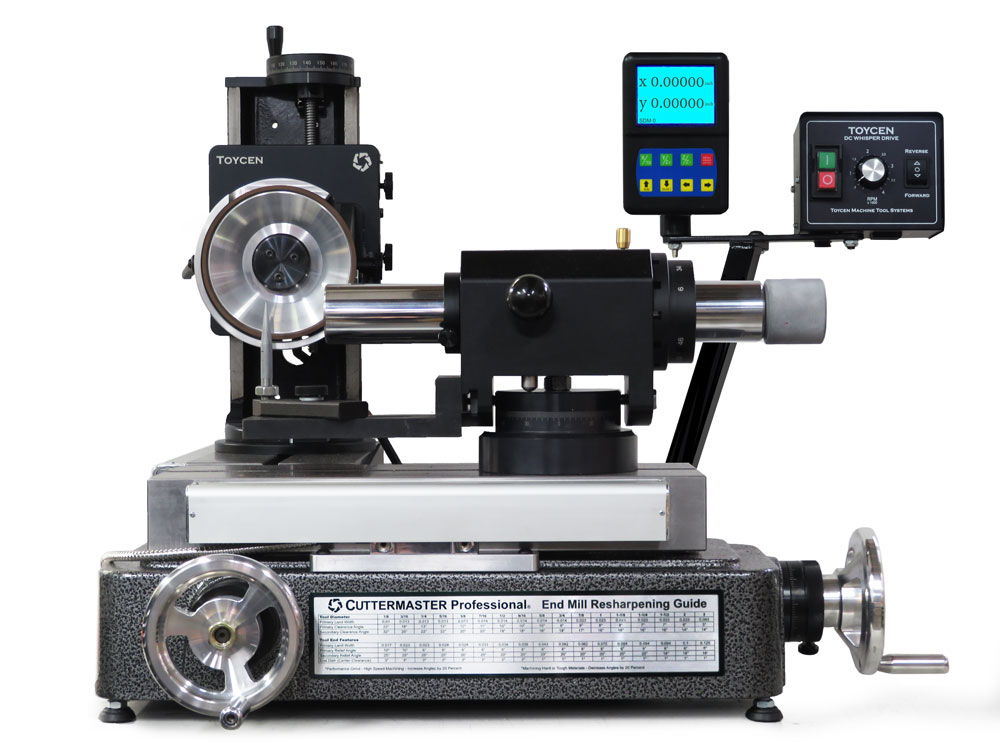
At the most basic level, the machine has to do more than make a tool look sharp. It has to recreate usable cutting geometry. That means primary and secondary relief need to be controlled, indexing needs to be accurate, and the wheel and spindle need to run with low vibration. If any of those are off, the tool may cut for a short time, but it will not cut predictably.
A proper end mill sharpening machine also needs to match the type of work in your shop. Some users only need to restore standard square end mills in common diameters. Others need to handle corner radius tools, multiple flute counts, ball nose profiles, roughers, or specialty carbide cutters. That is where machine design matters. A fixed-function unit may be fine for a narrow task, but it can become a limitation once your tooling mix expands.
Variable speed matters more than many buyers expect. Different tool materials and wheel types respond better at different surface speeds, and the ability to slow down or reverse in certain operations improves control. A machine that runs smooth at a controlled speed gives the operator a better chance of preserving geometry and avoiding heat damage at the edge.
Why general-purpose grinders fall short
A bench grinder can remove material. That does not make it a sharpening system. End mills demand controlled angles, repeatable indexing, and stable presentation to the wheel. Trying to freehand an end mill, or adapting a machine that was not built for cutter geometry, usually produces mixed relief, uneven lips, and a tool that cuts oversize or chatters.
This is where many shops lose money without realizing it. A poorly sharpened tool does not just fail sooner. It can hurt surface finish, increase cycle time, overload a spindle, and create inconsistent part quality. When the sharpened tool behaves differently from tool to tool, operators stop trusting reground cutters and go back to buying new.
That is not a sharpening problem. It is a machine capability problem.
Key machine features that affect results
When you evaluate an end mill sharpening machine, spindle quality should be near the top of the list. Low vibration is not a luxury feature. It directly affects edge finish and repeatability. A machine with chatter in the spindle or instability in the setup will print those flaws right into the cutting edge.
The indexing system is just as important. Flute-to-flute consistency has to be dependable, especially as flute counts increase. A machine that makes one cutting edge slightly different from the next will produce uneven cutting loads, and that shows up quickly in finish and tool life.
Tilt angle and swing range also matter because they determine what geometries the machine can actually reproduce. Shops often buy on diameter range alone, then realize later that the machine cannot handle the relief style or cutter form they use most. A broader adjustment range gives the machine a longer useful life, especially if your work shifts between production, repair, and prototype jobs.
Modularity is another serious consideration. If a machine can grow with accessories or application-specific attachments, it tends to hold value better inside a working shop. Today you may be sharpening standard end mills. Six months from now, you may want to add drills, lathe tools, inserts, or specialty cutters to the same sharpening station. A machine with expansion paths usually gives you a better return than a one-task unit that has nowhere to go.
Carbide, HSS, and the realities of wheel selection
Tool material changes the sharpening conversation. HSS is generally more forgiving, while carbide demands better wheel choice, tighter control, and a machine stable enough to support fine edge work. If your shop runs a high percentage of carbide, the machine and wheel package have to be selected with that in mind.
Wheel compatibility is often treated like an accessory issue, but it should not be. Diamond, CBN, and conventional abrasives all have different roles depending on material and geometry. The machine should make wheel changes practical and maintain alignment without turning setup into a half-hour project. If changing from one application to another is cumbersome, operators tend to postpone needed sharpening or use the wrong setup just to keep moving.
That trade-off usually costs more in tooling than it saves in time.
Throughput versus flexibility
Not every shop needs the same kind of end mill sharpening machine. A production environment with a narrow, repeatable tool range may benefit from a setup optimized for speed and minimal adjustment. A toolroom, repair operation, or mixed-job shop usually needs more flexibility, even if cycle time per tool is slightly longer.
This is where buyers need to be honest about actual use. If the machine will be used by one trained person on a stable tool mix, a more dedicated setup can make sense. If multiple users will sharpen different cutter types across changing jobs, adjustment range, clear controls, and repeatable fixtures become more important than raw sharpening speed.
The cheapest machine on paper often becomes the most expensive in practice when it cannot keep up with real shop variation.
Operator skill still matters, but the machine should help
A good machine does not remove skill from sharpening. It makes skill productive. It gives the operator controlled movement, repeatable reference points, and enough stability to get the same result twice. That is a major difference from improvised setups, where success depends too heavily on feel and individual technique.
Training time is part of the investment. Shops should expect a learning curve, especially when moving from outsourced sharpening or simple touch-up methods to full geometry restoration. But that curve should lead somewhere. A well-designed machine lets an operator build repeatable habits instead of relearning the process on every tool.
That is one reason purpose-built systems tend to outperform generic grinder arrangements over time. They reduce variability between operators and make sharpening less dependent on workarounds.
Cost justification is usually straightforward
Most buyers start by comparing the machine price to the cost of new tooling. That is a fair start, but it is not the whole picture. The real return comes from extending expensive cutter life, reducing emergency replacement orders, and keeping tools available when production needs them. There is also value in being able to inspect, touch up, and return a tool to service without shipping it out and waiting.
For shops running premium carbide end mills, the break-even point can come faster than expected. Even smaller operations feel the benefit when they stop treating worn cutters as disposable. One machine that restores useful geometry consistently can change how the entire shop manages tooling inventory.
That is especially true when the same platform can support more than one sharpening job. A machine built with real expandability can serve as a longer-term tool maintenance center instead of a single-purpose purchase.
What to ask before you buy an end mill sharpening machine
Start with your actual cutter mix, not the catalog ideal. Look at common diameters, flute counts, materials, and geometries. Then ask whether the machine can sharpen those tools with repeatable accuracy, not just theoretical compatibility.
Ask about spindle type, speed control, reversing capability, wheel options, indexing method, and attachment paths. Ask how setup changes are handled. Ask what support looks like after the sale, because even experienced machinists benefit from direct technical help when a new sharpening application comes up.
Most of all, ask whether the machine was designed by people who understand what a sharpened tool has to do in the cut. That shows up in the details – smoother operation, smarter fixtures, useful accessories, and fewer compromises in the geometry.
Cuttermasters has built its reputation around that kind of practical machine design. For shops that take tool maintenance seriously, the right sharpening system is not just a grinder on a bench. It is a way to hold accuracy, protect tooling investment, and keep good cutters working longer.
A sharp end mill saves money one edge at a time, but only if the machine behind it can deliver the same edge tomorrow.