
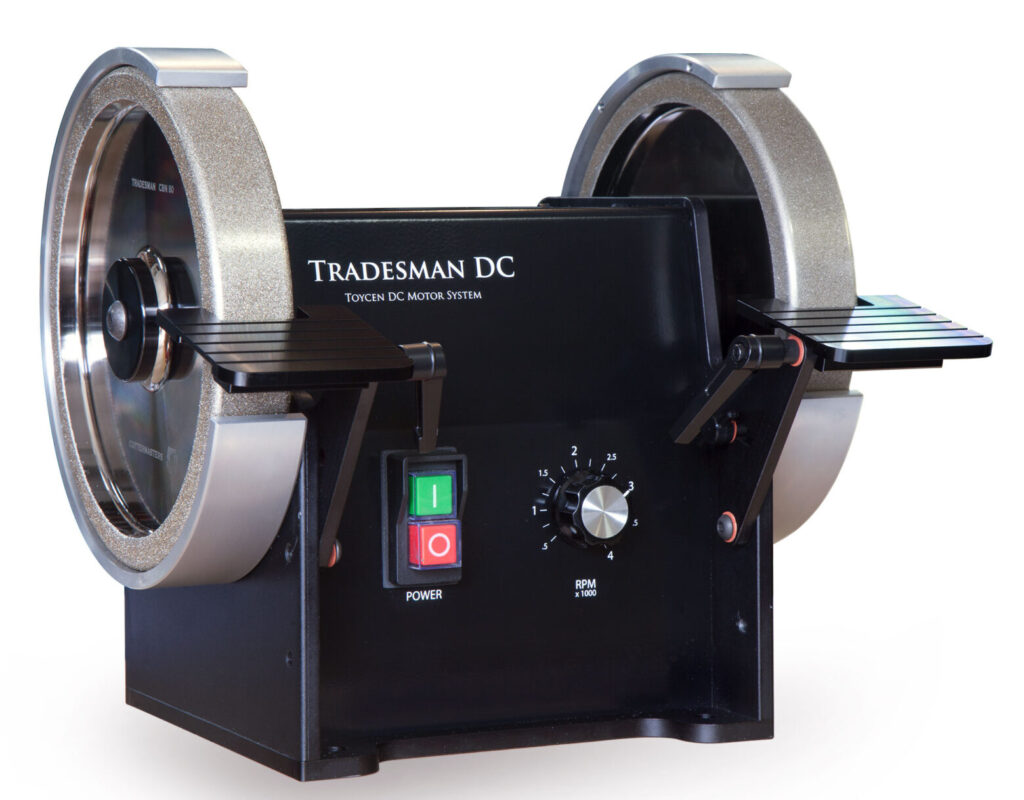
Deburring is part of most metal fabricating processes Sharpening,drilling, milling, laser cutting, punching, or rough grinding, and then somebody has to remove it without rolling the edge, overheating the part, or changing the geometry. That is where a variable speed reversing grinder for deburring earns its place. The right setup, gives the operator better control over the process.
A variable speed reversing grinder or belt grinder is a must have. There IS a correct speed for every process
Most deburring problems are not about whether abrasive contact happens. Any grinder can touch the edge. The issue is how the burr reacts when the abrasive meets it, and how stable the operator can keep that contact from one part to the next.
An accurate variable speed reversing grinder changes the direction of abrasive travel relative to the workpiece. That affects whether the burr is cut away cleanly, folded over, feathered, or pushed into a secondary edge condition. If you are working on thin stock, sharp corners, small tools, profiled edges, or parts that are awkward to hold, rotation direction can change the whole feel of the operation.
On a fixed-direction grinder, you often adapt your hand position to the machine. On a reversible machine, you can adapt the machine to the work. That sounds simple, but in a shop that processes varied materials and part shapes, it matters. Better approach angles usually mean less edge damage and less operator fatigue.
The role of variable speed and reversing in deburring
The first advantage is edge presentation. Some burrs shear off best when the abrasive approaches from the face side toward the edge. Others behave better when the contact comes from the opposite direction. Edge leading or edge trailing in knife apex finishing is a good evample
The second advantage is part control. If wheel or belt rotation tries to pull a part out of your hands or lift a thin edge, the job gets slower and less predictable. Reversing the rotation can make the same contact feel planted instead of unstable. For small metal parts, sharpened tools, knife blanks, or fine fabricated pieces, that difference is not minor. It is the difference between controlled deburring and chasing defects.
The third advantage is finish quality. Burr removal is often treated as a rough secondary step, but anyone producing close-tolerance parts knows that deburring can easily become a source of scrap. Wrong rotation can leave a smeared edge, inconsistent radius, or visible abrasion pattern. Reverse capability gives you another way to tune the finish without changing the whole machine setup.
Where reversing matters most
Not every deburring application needs reverse. On heavy plate with a broad edge break, a standard grinder may do the job well enough. But several applications benefit immediately.
Thin material is a common one. Sheet metal, fine blanks, and narrow edges are easy to catch or distort if the abrasive is driving the edge the wrong way. Reverse rotation can reduce edge grab and let you deburr without bending the part.
Complex profiles also benefit. Internal curves, notches, scallops, and formed contours often force the operator into less-than-ideal hand positions. With a reversing grinder, you can pick the direction that lets the abrasive meet the burr cleanly while keeping your hands in a safer, stronger position.
Tool maintenance is another area. Deburring sharpened tools, ground edges, and specialty cutters requires more than removing a wire edge. You may need to preserve a face, avoid rounding a corner, or keep a relief surface intact. In those cases, control of rotation direction supports precision, not just convenience.
Knife makers, woodturners, and fabrication shops see the same pattern. A burr is rarely just excess material. It is tied to edge condition, feel, and next-step performance. Reverse gives you a more precise way to manage that condition.
The Machine Matters
This is where buyers need to be practical. A reversing feature is valuable, but it does not make a low-quality machine precise. If the grinder has vibration, inconsistent speed, weak tracking, poor spindle behavior, or limited adjustability, reverse only changes the direction of the same problems.
For deburring, or other precision processing, the machine has to run smoothly. Low vibration matters because burr removal is a light-contact operation on many parts. Excess machine movement translates directly into chatter marks, uneven edge breaks, and operator overcorrection. Variable speed matters too. Some burrs come off cleanest at lower surface speed, especially on heat-sensitive materials or small edges where aggressive contact removes too much base material.
The abrasive system matters just as much. Belt, wheel, flap, non-woven, and specialty finishing media all behave differently in forward and reverse. Some belts track fine in either direction. Some contact wheel setups are more sensitive. Some deburring wheels are designed to cut best in a preferred direction. A good machine gives you the control to use those differences to your advantage instead of fighting them.
The real value of accurate,variable speed reversing
Accurate parts, soft material, keen edges require a thoughtful touch. when the process is controlable its a completely oportunity
That matters whether you are cleaning up a machined component, refining a knife blank, touching a sharpened edge, or processing a run of fabricated parts. Good deburring protects the geometry you paid to create. A reversing grinder gives you a better chance of doing that on the first pass, with less guesswork and less waste.
If deburring is still being handled as a nuisance step in your shop, that is usually a sign the setup is costing more than it should. The right grinder does not just remove burrs. It gives you control over what stays on the part when the burr is gone.