
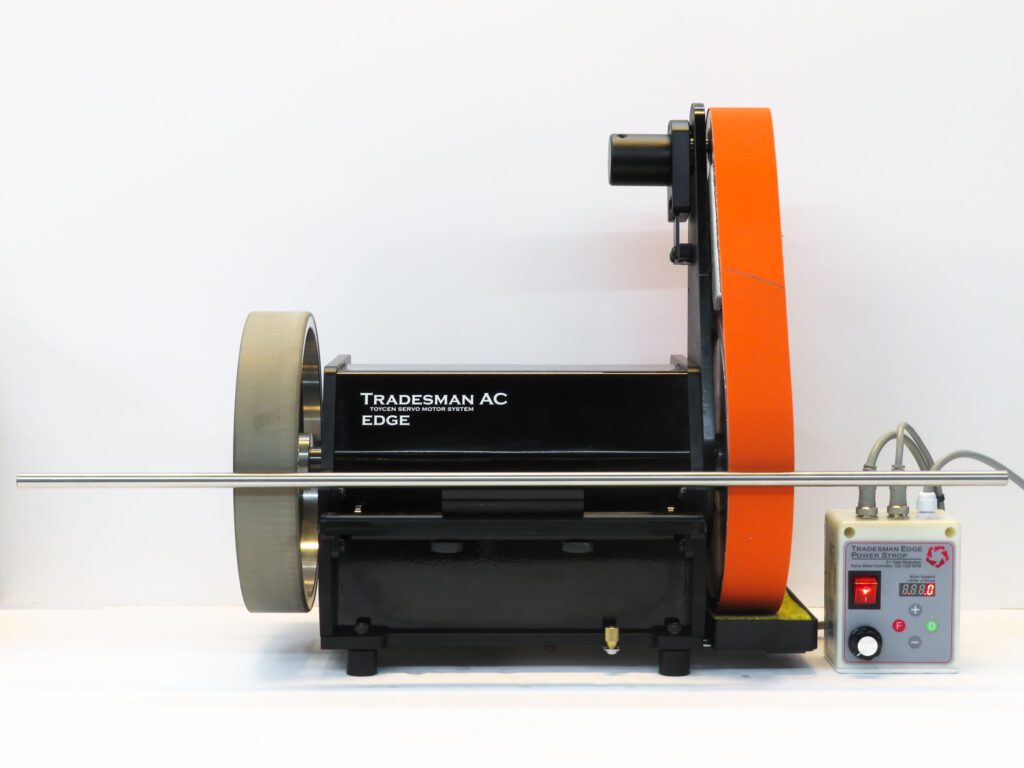
- Tradesman EDGE Apex Knife Sharpening System Designed by Jeff Toycen
- Introduction: A powerful Geared Belt Drive DC or AC Work Station produced by a machine tool company to Aerospace Tolerances.
- Design and Features: Two Versions AD Servo Drive, or 130Volt Brushed DC Variable speed reversing 100 to 1000 RPM
- Functionality: Precise wheel runout Rail is mounted on center Easy calculation of angles
- Performance: Efficiency, precision, durability
- Comparison: How it stacks up against other sharpening systems
- Applications: Suitable knife types, industries, or user levels
- Conclusion: Pros, cons, and final thoughts

Edge Movies and Instructional videos ~~ Edge users
Wheels Designed by Jeff For Apex and Power Strop
2025 Contact / Strop Wheel
Resin Bond wheel
250 mm Profile Generating Form Wheel for Serrated Blades
200mm Profile Generating Form Wheel
250 mm diameter 60mm Wide Resin Bond Profiling wheel
Using a Tormek SVH-320 to sharoen a Brazed Carbide Leather Skiver blade
Eric Ho, Clever customer, and Innovator.
Excellent Description of EDGE APEX Atributes and Benefits
I have two Tradesman sharpeners, a highly modified 8” Tradesman DC bench grinder and a (slightly) modified Tradesman Edge Apex.
The Apex is expensive. It is not for a hobby sharpener. IMHO, it is not even for a new sharpening business. However, as one’s business gets busier, an Apex will help you make more money in less time. This is because it has:
1 – Variable speed motor
2 – High quality bearings for very low runout (shaft wobble)
3 – Balanced grinding wheels
4 – Quiet operation
5 – Multiple mounting holes for mounting accessories
6 – Ability to use Tormek jigs
7 – Ability to mount TWO sets of Tormek guide rails at once
8 – 13” (335mm) between the two grinding wheels
9 – 3mm thick resin-bond, unique diamond formulation wheels that should last 15K-20K knives
10 – Ability to skip using a 400 grit wheel – go from the 100 grit wheel directly to the 1,000 grit wheel.
11 – Option to run a 2” x 42” belt for thinning knife blades
12 – dust-free via wet sponge trays
13 – a responsive manufacturer open to feedback and suggestions
I have four Tormeks®. Over the years, many people have ingeniously modified them to run edge trailing (Frontal Vertical Base), run two wheels, speed them up, 3D print drip trays, and even grinding using the sides of CBN or diamond wheels. However, even such mods have their limits.
1 – Even with a speed-up modifier, the Tormek® still runs at only 140 rpm in a country with 60 Hz power (about 120 rpm for countries with 50Hz power). The Edge can be ordered with 50-500 rpm, or 200-1,000 rpm. I run mine at 500 rpm; Ryan at Grind Knife Sharpening runs his at 600 rpm. So an Edge is 4-5 times faster.
2 – Cuttermasters claim the shaft concentricity (runout) is .0002” (5 micrometers). That’s two-tenths of a thousandth of an inch. For comparison, I had a grinder that was .030”. (It vibrated badly; I returned it). Cuttermasters are SMOOTH and vibration-free. They’re a joy to work with.
3,4 – Low runout and hand-balanced wheels means low running noise. I’ve found that, instead of ignoring/missing potential customers, I can actually talk to them while working. Quiet grinder – more sales!
5,6 – The grinder body has multiple holes for mounting various accessories, including Tormek® jigs.
7 – I have TWO sets of Tormek® guide bars mounted – one using the optional TE-TB bracket, and the other being the Edge’s front bar. The top bar is pre-set for 15 degrees, whilst the front bar is pre-set for 20 degrees. When I need to grind at 20 degrees (Henckels with bolsters, cleavers) I merely loosen four thumbturn bolts and swing the 15 degrees top bar out of the way. Takes about 15 seconds.
7 – Tormeks have 9” (225mm) between the inner edges of two grinding wheels. The Edge has 13” (335mm). This means I can grind a 12” long slicer without hitting the other wheel, and not have to take off that wheel.
8 – 3mm thick of resin-bond diamonds means wheels should last 15-20,000 knives. Ryan says he’s done 7,000 knives so far and it’s gone down .5mm. If you do the volume, they’re the best VALUE, with the lowest cost per knife.
9 – The longevity and special formulation means one can go from 100 to 1,000 grit. With CBN wheels, Vadim recommended going 80/160 – 400 – 1,000. It wasn’t that you couldn’t skip the 400 – it was to avoid quickly wearing out a 1000 wheel with its thin CBN coating. This saves time and also the cost and space for another machine for the 400 grit wheel.
10 – Thinning blades is commonly required for restaurant knives, as they get sharpened much more often than homeowner knives. With the Edge, you can slip a 2 x 42 belt over a grind wheel and use it for eliminating swales and for thinning blades. I believe it was Pete at Pete’s Knife Sharpening that convinced Jeff Toycen to make this. Pete has a YouTube video describing how he thins knives, handheld, using a laser line as a guide.
11 – I ran a vacumn with my Trademan DC bench grinder. The Edge’s wet sponge trays allows for dust-free grinding without the noise, as well as the cost and power consumption of a vacumn. Again, I can interact with potential customers while working!
12 – Finally, Cuttermasters is a small company that listens to feedback and innovates. The Edge is a result of four years of innovation. It’s a pleasure to work with a company that evolves its products.
Cuttermasters engineering and prototyping is in Canada but manufacturing and distribution is out of the US. Machines run on 120 Volts but 240 Volts is an option.